
NEWSLETTER #40 (English) from Urs & Izzy: Summer honey and prying eyes!


August 2026 (Issue #40)
We have just finished the second (and last) harvest for 2026. Summer (forest) honey is now available! Last weekend (and during the whole week, we have been truly boiling under the protection beekeeper suits. We had a choice… between almost fainting because of heat, or fainting because of bee stings. Hmmm what a choice! Well, we survived :-)
And so we harvested for you a really mellow, fine and tasty summer honey. And also, unfortunately, we had prying eyes on the hive. Whose eyes? Keep on reading…and help us finding these unwanted guests!
The newsletter is not AI written, and it is not ‘blanket’ sent either! But we really hope you enjoy it…
If you don’t want to receive the newsletter, just WhatsApp or email Izzy and say “NO”. Are you enjoying it? Tell us at baerenhonig@gmx.ch, or WhatsApp us, if you prefer. We'd love to hear from you!
News from the Beehives

We had prying eyes during the harvest. And, no, it was not human prying eyes (as our surreal experience last year), this time… it was animal eyes. And pretty nasty ones. We discovered that the infamous Asian hornets have reached our Witikon forest, and they have settled here. Izzy, who also ‘sees everything’, saw them zooming around the hive. These are not the European hornets, who sometimes kill a bee or two. These are very aggressive b*****, who would decapitate the foraging bees as they leave the hive, as a threatening method. The rest of the bees get paralyzed by fear, do not want to leave the colony, and do not harvest nectar. Once the colony weakens by the lack of food, the hornets will enter the hive, kill the remaining bees and fest on the larvae, which was their original intention.
They are real predators, without any enemies in Europe. Except Izzy, of course, who happily smashes them unapologetically. Unfortunately, they are also dangerous to humans; they have a 3 mm stinger, so please do NOT try to kill them. Better, observe which direction they leave – the important thing is to locate the nest, so the authorities can destroy all of them at once. Here you can find the Zurich official notice of the Asiatic hornet, so you can familiarize yourself with how it looks, and its characteristics. If you see one (please do not confuse them with the European hornet (Vespa Cabro), which is protected, please report it here to the authorities! They are relatively easy to distinguish. The invasive species has yellow legs, and an almost black back.
Where is my Honey...?
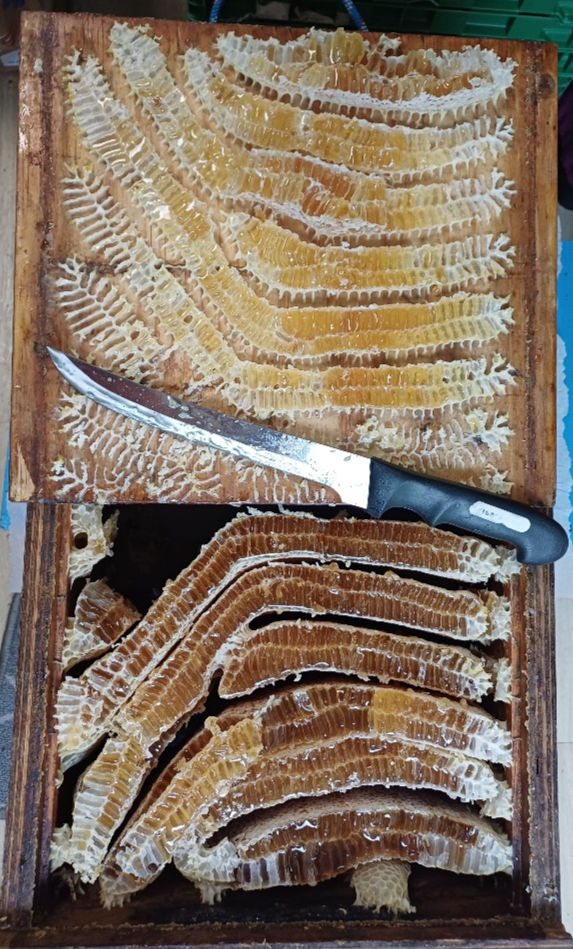
Your forest (summer) honey is…ready for you!!! This year nature was plentiful, and the bees were very laborious.
Urs and Izzy are very proud of their bees, who, this year, seem to have graduated –although not with honors- in architecture and engineering. How do we know it? Because they did build a full house… but, there was not even one straight wall! Look at the two photos – solid, wild comb honey everywhere, yet made 'art nouveau' style -curved lines, twists and turns.
The photo on the right shows what happens when you leave a bee colony to grow 'unattended'. You just provide them an 'empty flat'. This is what happens in nature, the bees fill the space, in a 'naturally appropiate' manner. Surely for them it makes sense, but, what a mess!
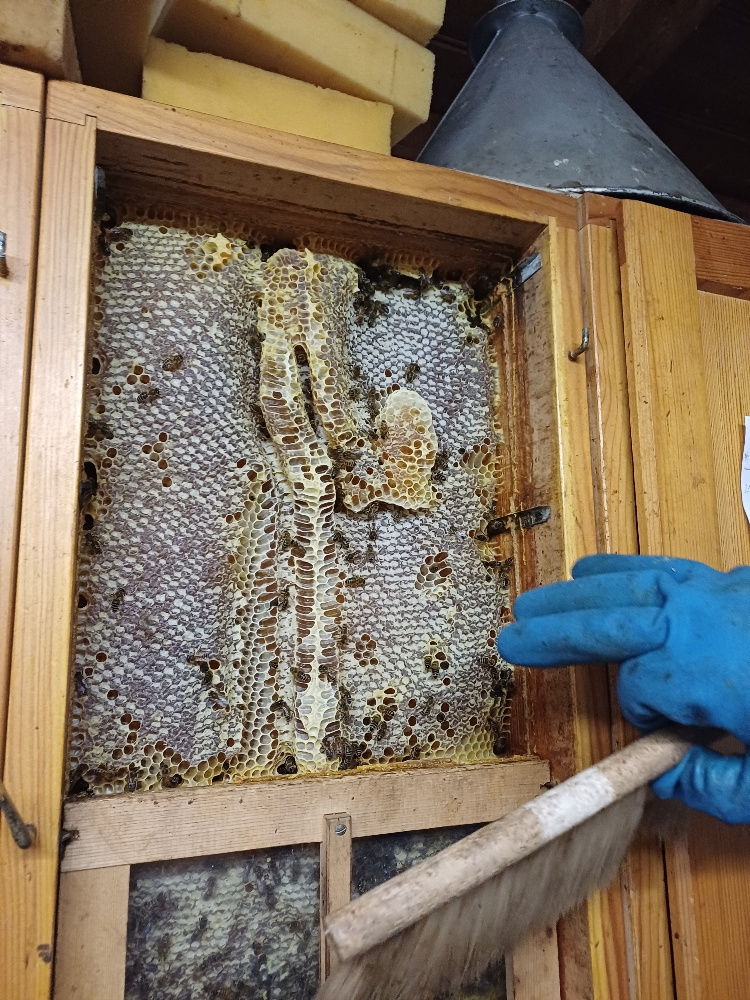
The photo on the left shows that it even happens when you give them the plans of 'where and how' to put the honey. They still make whatever they want. In this case, a full wild comb filled with honey, locking the access to the honey frames.
So, we have a lot of wanna-bees engineers and architects. They just need to come back and study a little bit more for next year.
Each one of the combs weights between 2 and 4 kilos, and are very flimsy...so it takes a lot of patience and cold blood to handle them, but it's worth it. All of you, who love comb honey will have a blast this year!
Of couse we have also honeypots like every year, here is a little table of what we have (until we get around writing it on the website)
1000 g pot | 500 g pot | 250 g pot | Combhoney* | |
Spring / flower | --- | 17 CHF | 11 CHF | 70 CHF/Kg |
Summer / forest | 32 CHF | 17 CHF | 11 CHF | 70 CHF/Kg |
*the combhoney has been '``cut' in portions of between 300g - 500g, and the price is weight-dependent. For those of you who want to make a present, or are honey-lovers old style, we have full combs (>2 kg) available.
Whatever your preference is, as soon as we get your order, Urs (or Izzy) will deliver on his bike to your mailbox! For those of you who pre-ordered summer honey, you'll have your honey already this weekend!
Facts & Figures
Our ‘new’ enemy, the Asiatic hornet (vespa velutina), is an invasive species, originally from Southeast Asia. It arrived to France in 2004, hidden in imported pottery from China. They are about 3 cm long, and they have a very nasty stinger, 3 mm long.
During late winter, these hornets build a primary nest, of the size of a football, usually at1 – 2 meters high, hidden on the bushes. In spring, they move to a ‘secondary’ main nest, built at about 15 – 20 meters high, at the top of the trees. This nest is very big, between 60 cm to 1 meter in diameter, where thousands of hornet workers, and dozens of hornet queens, breed into large swarms. The nests look like wasp nests – ...but much much larger. Looking for them is not easy – they hide among the tree leaves.

How to find them? It is very difficult, and nothing has been able to stop them spreading in Europe. But human ingenuity and creativity thrive on these occasions.... so we started thinking...and humming. We found a potential alley: the hornet nest is very well insulated, yet, the same as with the bees, they keep their nest at about 30 – 34 C, so, at night, there is a slight gradient of temperature with the surrounding air.... which makes them suddenly visible through ‘heat cameras’. So we did that; at 4h30 a.m. we scanned, together with our bee-godfather and his professional hunter friend, with a very expensive heat- camera, tree-by-tree the Witikon forest. All done "by hand” (Witikon is a no-drone flight area) until we found the location. You can see it on the photo. Ha! We have reported it to the authorities and will be looking forward its removal! Not one day without an adventure!
Did you know that...?
A Queen bee is a very special member of the colony, yet, researchers have recently discovered that she is much much more special than what we thought! We all know that a queen Bee is fed Royal Jelly for 8 days, whereas normal bees are only fed it for 3 days.
Now, we know that there is a whole royal court that prepares everything specially for her – including the nest, the diet, and the ‘personal attendants’. Yes, when the Colony decides that they need a new Queen, it appoints a group of young bees, which change their metabolism, so they can create a special wax for the Queen cells. This wax is enriched in poly-unsaturated fatty acids (PUFAs), like antioxidant ‘omega-3’ for the future queen.
Also, just a selected group of bees actually ‘build’ the royal nest, as its structure and architectural structure is very different – it is more pliable and resilient than the rest of the comb, almost like armor-plated.
And also a well-defined cohort of young bees are also dispatched to look for a very specific type of pollen, rich on one specific protein, called “royalactin’, so their royal jelly is really Royal.
And, not just that, the bees that attend the Queen, by feeding and cleaning her when she is born, are also special – they have a slightly increased body temperature, and their enzymatic mix is different from the ‘general bee population’.
That is a full cohort of specialized bees that change their own nature, to prepare and help the future Queen. That explains why the Queen lives up to five years, whereas the worker bees live at maximum 6 months. It is almost incredible, isn’t it?. Yet, you don’t have to believe me...there is a 30 pages article in Nature!
Not so different than the treatment that Royal houses have historically received in human society, but, of course, we are not asking the Queen of England to give birth to 2,500 future citizens ...per day!

Swiss Bees
Here is the second on the series of bee-grafitti. Each drawing represents a behavior of the bees, or an activity at the apiary undertaken by the beekeeper.
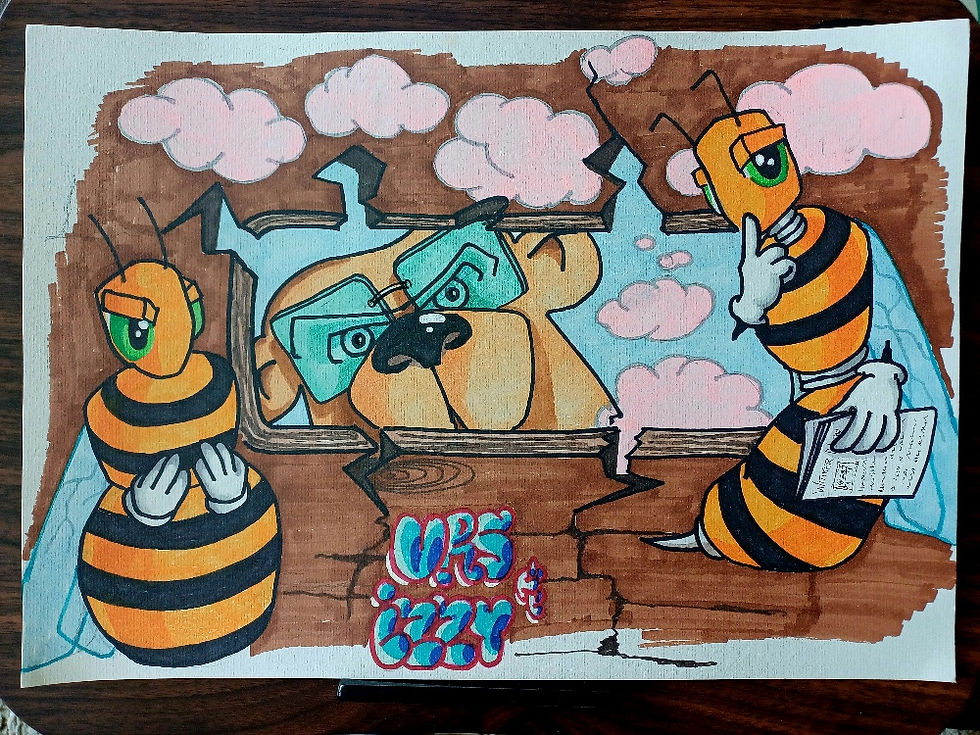
So.... what is Urs doing here, that annoys so much the bees? (tip: this is something that we must do AFTER we collect the honey)
Send us (via whatsapp / email / SMS) your answer. The winners, will receive in their mailboxes a bio-Bienenkuss (lippenbalm mit propolis).
And the answer (and also the most creative ones) will be presented in the next bimonthly!
And this is a beautiful rhyme that one of our lovely bee-lovers wrote for the previous one: "Alle weg, ob Mensch ob Tier, unser Honig der bleibt hier!!!!"
.
.

Comments